
China’s Energy Juggernaut: A Foundational Play in the AI Race
In the high-stakes global race for Artificial Intelligence dominance, two superpowers, the United States and China, appear to be approaching the challenge from vastly different, yet equally critical, angles. While the U.S. has focused heavily on securing a lead in advanced semiconductor manufacturing – the ‘brains’ of AI – China has quietly, but with incredible speed, moved to solidify its position as an energy superpower. This strategic divergence highlights a fundamental truth: both cutting-edge chips and an abundant, stable energy supply are indispensable for the burgeoning technology industry.
China’s approach signals a clear understanding that guaranteeing energy supply is the foundational first step towards mastering emerging industries like AI, robotics, and advanced materials. The sheer scale and speed of its energy infrastructure build-out are nothing short of breathtaking, demonstrating a national commitment to securing its future technological and economic leadership.
The Astounding Scale of China’s Energy Expansion
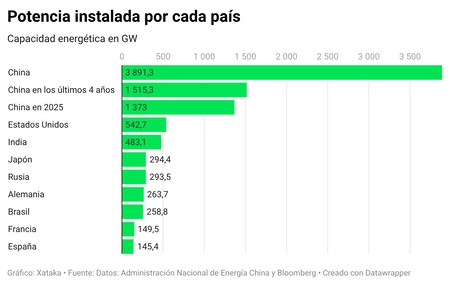
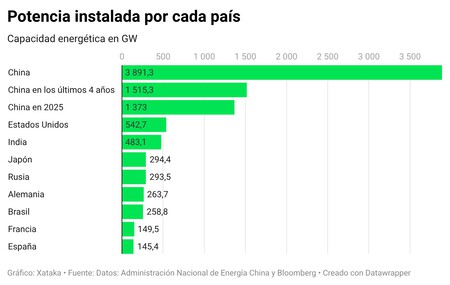
Recent data from China’s National Energy Administration, as reported by Bloomberg, reveals the staggering pace of this expansion. In 2023 alone, the Asian giant added an astonishing 542.7 Gigawatts (GW) of new generation capacity to its existing grid. This colossal addition propelled China’s total installed capacity to an incredible 3,890 GW. To put this in perspective, China News noted that this represents a 16.1% increase in capacity within a single year.
Putting the Numbers in Perspective: More Than Entire Nations
While raw figures can be difficult to contextualize, the magnitude of China’s energy drive becomes clear when compared to other global powers. The 542.7 GW added by China in just one year is more than the entire installed electricity generation capacity of major industrialized nations such as India, Germany, or Japan, according to data from the International Energy Agency (IEA). Only the United States, with its approximately 1,373 GW available on its power grid, currently surpasses China in total operational capacity.
However, extending the time horizon back just four years paints an even more dramatic picture. In that short period, China expanded its capacity by a mind-boggling 1,515.3 GW. This four-year growth alone is significantly more than the entire current operational capacity of the United States. Such rapid expansion underscores a strategic intent to not just meet, but far exceed, its projected energy demands for decades to come.
| Metric | China (2023 Additions) | China (Total 2023 Capacity) | China (4-Year Growth) | United States (Total Capacity) | India (Total Capacity) | Germany (Total Capacity) | Japan (Total Capacity) |
|---|---|---|---|---|---|---|---|
| Capacity (GW) | 542.7 GW | 3,890 GW | 1,515.3 GW | ~1,373 GW | ~425 GW | ~235 GW | ~300 GW |
| Comparison Note | More than entire capacity of India, Germany, or Japan | Largest in the world by significant margin | Exceeds entire current US capacity | Second largest global capacity | Less than China’s 1-year addition | Less than China’s 1-year addition | Less than China’s 1-year addition |

Why This Energy Push is Critically Important
China’s ambitious investment in energy infrastructure serves multiple strategic objectives, all of which are interconnected and vital for its long-term national interests:
- Guarantee Stable and Abundant Supply: Reliable power is the bedrock of modern industry. For energy-intensive sectors like data centers, advanced manufacturing, and particularly AI, an uninterrupted and ample supply is non-negotiable.
- Minimize Dependence on Fuel Imports: By expanding domestic generation capacity, especially through renewable sources, China aims to reduce its vulnerability to volatile global energy markets and geopolitical tensions that could disrupt fossil fuel imports.
- Competitive Advantage in Growth Industries: An oversupply of cheap, reliable power is a formidable competitive advantage. It lowers operational costs for energy-intensive industries such as AI model training, large-scale data processing, advanced robotics, and the production of new materials, making China a more attractive hub for these cutting-edge sectors.
- Energy Security and Industrial Resilience: A robust and diverse energy grid enhances national security, making the country more resilient to external shocks and internal disruptions.
An Engineering Feat: Replicating a Century of Progress in Half a Decade
From an engineering perspective, what China has accomplished in recent years is nothing short of a modern marvel. The widely cited comparison highlights the speed: what took the United States roughly a century to build – a comprehensive national electricity grid – China has replicated and surpassed in less than half a decade. This rapid deployment of critical infrastructure is a testament to unparalleled planning, coordination, and execution capabilities.

Building electrical infrastructure, much like constructing massive data centers, is neither simple nor instantaneous. It demands meticulous long-term planning, complex logistical coordination for materials and equipment, and a highly skilled workforce for both construction and operation. Furthermore, securing permits, conducting environmental impact assessments, and managing community relations are significant hurdles in any large-scale project. China’s ability to navigate these challenges at such an accelerated pace implies a streamlined bureaucracy and a national commitment that overcomes typical delays.
This unprecedented level of manufacturing and installation not only demonstrates China’s industrial prowess but also contributes to a critical learning curve effect. By deploying technology at such a vast scale, China inherently drives down the per-unit cost of energy generation and transmission technologies, making them more affordable for future domestic and potentially global implementation.
The ‘How’: A Diversified Strategy with a Renewable Core
Achieving such immense capacity growth in record time is difficult enough, but the ‘how’ is as important as the ‘how much.’ A significant portion of this growth stems from China’s aggressive investment in renewable energy, primarily solar and wind power. Unlike traditional fossil fuel plants, these intermittent sources present unique challenges for grid management due to their variable output.
China isn’t merely installing panels and turbines; it’s simultaneously redesigning and modernizing its national grid to accommodate these intermittent sources. This involves sophisticated energy management systems, forecasting tools, and the development of ancillary services to ensure grid stability when the sun isn’t shining or the wind isn’t blowing.
Nevertheless, China’s energy strategy is pragmatic and diversified. While renewables are surging, the construction of coal and gas-fired thermal power plants has also reached record figures. These conventional sources continue to provide essential baseload power and grid stability, illustrating China’s balanced approach to energy security. Furthermore, nuclear and hydroelectric power continue to see steady, albeit more modest, increments in capacity, contributing to a robust and multifaceted energy mix.
| Energy Source | Contribution to Recent Growth | Key Role/Advantages | Associated Challenges |
|---|---|---|---|
| Solar Power | Leading contributor (massive additions) | Clean, increasingly cost-effective, decentralized potential | Intermittency, land use, grid integration complexity |
| Wind Power | Significant contributor (large-scale projects) | Clean, declining costs, often complementary to solar | Intermittency, geographical limitations, visual/noise impact |
| Coal-Fired Thermal | Continued significant additions (record figures) | Reliable baseload, grid stability, abundant domestic resource | High carbon emissions, air pollution, long-term environmental goals |
| Natural Gas | Steady additions | Cleaner than coal, flexible, quick ramp-up for peaking power | Import dependence, methane emissions, cost volatility |
| Hydroelectric | Modest but consistent increments | Renewable, flexible, good for baseload and peaking | Environmental impact (dams), geographical limitations, drought sensitivity |
| Nuclear Power | Modest but consistent increments | Low-carbon baseload, high energy density, long operational life | High upfront cost, public perception, waste disposal, safety concerns |
The Nuances of Capacity vs. Generation: The Plant Factor
It’s crucial to understand that immense installed capacity doesn’t automatically equate to round-the-clock power generation. The concept of ‘plant factor’ (or capacity factor) is key here. While a coal or nuclear plant might operate at a 70-90% plant factor, producing electricity almost continuously, solar and wind farms have significantly lower plant factors, often in the 20-40% range, due to their inherent intermittency. This means that to achieve the same amount of actual energy output (terawatt-hours), a country needs to install substantially more renewable capacity than it would conventional capacity.
China’s strategy acknowledges this. Building a vastly overbuilt renewable capacity, backed by a significant amount of traditional baseload power, is one way to ensure that even with lower plant factors, the overall grid can meet demand.
The Energy Superhighway: UHVDC Transmission
Moving vast amounts of electricity from energy-rich but sparsely populated regions (like the sunny Gobi Desert or windy western plains) to the industrial heartlands and megacities (such as Shanghai on the eastern coast) is a monumental challenge. China has tackled this with an unparalleled infrastructure project: the Ultra-High Voltage Direct Current (UHVDC) transmission network.
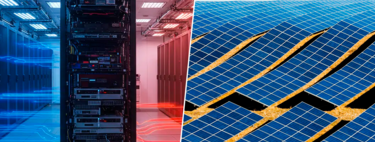
This ‘energy superhighway’ utilizes some of the world’s largest ultra-high voltage transformers and transmission lines, minimizing energy loss over thousands of kilometers. UHVDC technology is far more efficient than traditional AC transmission for long-distance bulk power transfer, allowing China to leverage its geographically dispersed renewable resources effectively.
The Next Frontier: Energy Storage Solutions
With massive renewable capacity and efficient transmission, the next critical challenge for China is energy storage. What happens to the excess energy generated during peak solar or wind production? China is tackling this head-on with colossal investments in two primary areas:
- Lithium-ion Batteries: Massive grid-scale battery storage facilities are being deployed and developed, offering rapid response times and flexibility to stabilize the grid and store excess renewable energy for later use.
- Pumped-Hydro Storage (PHS): As the most mature and widely deployed grid-scale storage technology, PHS involves pumping water uphill to a reservoir when electricity is abundant and cheap, then releasing it to generate power when demand is high. China is a global leader in PHS deployment.

Broader Implications: Geopolitical, Economic, and Environmental
China’s energy strategy extends far beyond mere domestic supply. It has profound geopolitical, economic, and environmental ramifications:
- Geopolitical Leverage: Energy independence reduces foreign policy vulnerabilities and enhances China’s negotiating power on the global stage.
- Economic Competitiveness: Lower energy costs translate directly into competitive advantages for Chinese manufacturers and tech companies, solidifying its role as the ‘world’s factory’ and increasingly, its ‘world’s lab’.
- Environmental Paradox: While China is building more renewable capacity than any other nation, its continued reliance on and expansion of coal-fired power presents a complex environmental paradox. Balancing economic growth, energy security, and climate commitments remains a delicate act.

The strategic choices made by China today will shape the global technological landscape for decades. By prioritizing energy, China is not only addressing an immediate need for its burgeoning AI sector but is also laying down a fundamental infrastructure that will empower its entire economy.
The AI Race: An Energy-Intensive Future
The future of AI is inherently energy-intensive. Training advanced AI models, running vast data centers, and powering robotic manufacturing facilities demand immense amounts of electricity. Estimates suggest that the energy consumption of AI data centers could soon rival that of small countries. By proactively securing an abundant and diverse energy supply, China is positioning itself to be the indispensable power source for the global AI revolution, regardless of who leads in chip design or software algorithms.

This ‘energy first’ approach forces other nations, particularly the United States, to reconsider their own infrastructure priorities. While a focus on advanced chips is vital, the underlying power required to run those chips at scale is equally, if not more, critical. China’s rapid energy build-out serves as a stark reminder that in the interconnected world of advanced technology, the foundational layers – like a robust energy grid – are often the most crucial, even if less glamorous.
Conclusion: China’s Strategic Foresight Powers the Future
China’s relentless expansion of its energy infrastructure, a monumental undertaking executed with unparalleled speed and scale, is a strategic masterstroke in the ongoing global technological competition. By adding more electricity generation capacity in a single year than many developed nations possess in total, and by building an energy superhighway to distribute it, China is not just meeting current demands; it is proactively constructing the foundation for its future dominance in AI, advanced manufacturing, and other high-tech industries.
This ‘energy first’ philosophy highlights a profound understanding of the fundamental requirements for technological leadership. While the U.S. and its allies focus on the ‘brains’ of AI in the form of advanced chips, China is systematically ensuring it has the ‘lifeblood’ – the abundant and reliable power – to fuel them. This divergence in strategy sets the stage for a fascinating, and potentially transformative, shift in global power dynamics, reminding us that in the race for tomorrow, having the power to keep the lights on might just be the ultimate competitive advantage.
Latest posts

Traditional vs digital advertising in 2026: which one to choose?

Duplicate Content: A Problem for Your Natural Referencing?

SEO Forums: The Complete List [2026]
How to build a successful linking strategy?

5 tips for successful marketing based on storytelling

Instagram profile photo: the practical guide [+Outils]

Twitter: 7 strategies to stand out

How to increase your awareness using digital?

Why premium domains improve your customer acquisition cost (CAC)