
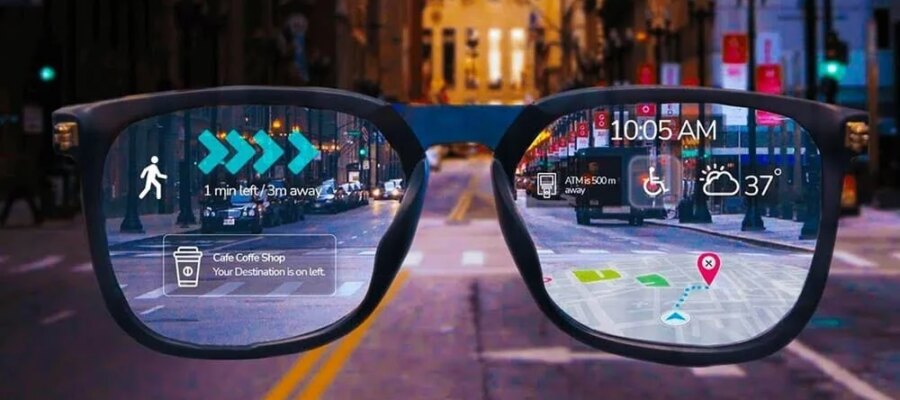
Today, frames no longer limit themselves to correcting vision: they amplify our senses and improve our daily lives. Some even go so far as to integrate a discreet and intelligent hearing aid. Glasses that listen, translate, analyze or project information: welcome to the era of augmented vision. Explanations.
Smart hearing glasses
Until recently, vision and hearing were problems treated separately. But innovation is a turning point: smart hearing glasses combine vision and sound in a single accessory.
Discreet and efficient listening technology
This type of glasses incorporates a invisible listening assistantdirectly hidden in the temples of the frame. The device detects surrounding sounds and it amplifies them in a certain sense directionalthat is, focusing on the voice of your interlocutor rather than on the ambient noise.
You can adjust the amplification level depending on the context: meeting, restaurant, outdoor, thanks to different noise management mode. A technological and aesthetic feat at the same time.
Unfortunately, many people who suffer from hearing loss are still reluctant to wear hearing aids for fear of how others will look at them. With these frames the stigma disappears. If you are interested in the solution, find your Nuance Audio glassesa framework that integrates a discreet and innovative listening assistant.
The main trends of connected glasses in 2025
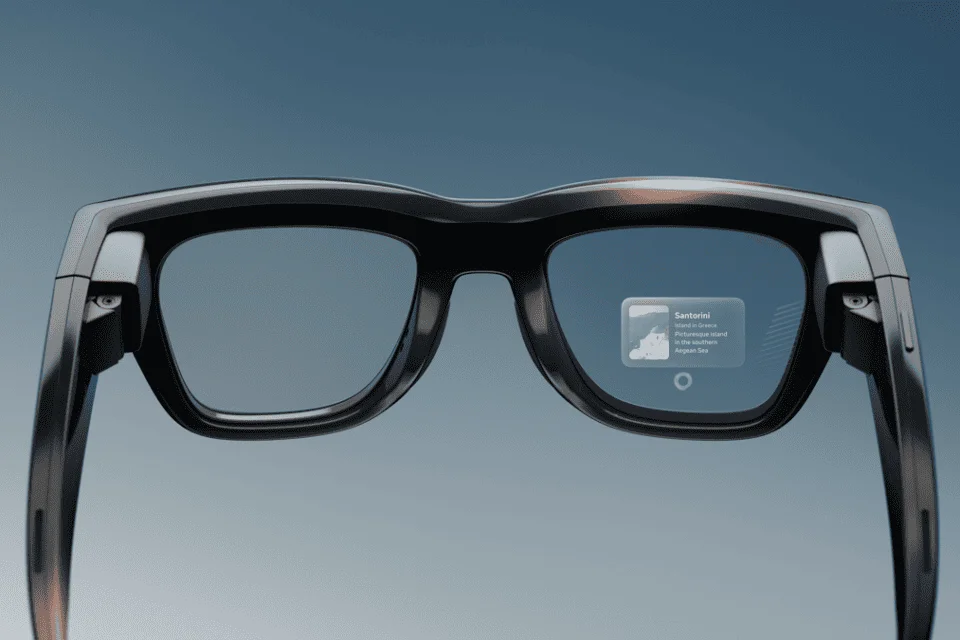
After conquering our pockets with smartphones and our wrists with connected watches, technology has now settled on our nostrils.
Augmented reality and artificial intelligence at your fingertips
GPS, notifications, message summary, real-time translation, photos, videos, etc., thanks to augmented reality (AR) and artificial intelligence, the latest generation frames work wonders.
The “Ray-Ban Meta”: a new reference
In September 2025, Meta and Ray-Ban clashed hard over their connected eyewear model. They include a mini-screen invisible to the naked eye, capable of displaying a wealth of information: incoming calls, routes, messages, weather, etc. All controlled by voice via Meta AI.
Here is a demonstration video:
➡️ The bet is clearly a winning one: more than 2 million copies sold since 2023 and sales tripled in the first half of 2025.
A rapidly expanding market
According to Facts & Factors, the smart glasses technology market is expected to reach a value of $64.12 billion by 2032.
This dynamism is explained by diversification of uses (health, sport, work, mobility) and from important technological partnerships which are multiplying. In addition to Meta, Google is now working with several optical brands to integrate its Gemini assistant into frames.
Challenges to overcome
More natural gestures and voice controls
No more buttons or touchpads, you have to rely on gestures and micro-movements. Thanks to the sensors integrated into the frame it becomes possible to click, scroll the text or accept a call with a simple movement of the finger or a blink of an eye.
Some brands are also experimenting with silent controls : A user can interact with their voice assistant through simple lip movements, without speaking out loud. These innovations aim to make use more fluid, intuitive and discreet. We are thinking in particular about use in public.
Improve autonomy
Logically, a pair of connected glasses should be able to run all day without requiring constant charging. Recent advances already make it possible to double the autonomy compared to the 2023 models, while maintaining a weight of less than 50 grams. Finally, the glasses could be charged via induction as soon as they are placed in the case, like wireless headphones.
Security and data protection
This is the thorny topic. With on-board cameras, microphones and sensors, being filmed without your knowledge will perhaps become commonplace. The issue of privacy and data collection is crucial.
According to the National Commission for IT and Freedoms (CNIL), Video surveillance regulations do not apply to smart glasses. RGP applies, but not for home use.
One thing is certain: in the event of mass adoption, the authorities will have their work cut out for them…
Optician: a changing profession
Faced with these hybrid products, the role of the optician expands. It’s no longer just about fixing a frame, but about customize a connected solution. This requires new skills: understanding associated mobile applications, managing connectivity, configuring voice assistants, etc.
Which the most advanced brands are already aiming for continuous training of their teams and so on demonstration spaces to test connected glasses in store. This engaging approach promotes trust and helps customers adopt these new technologies without apprehension.
Latest posts
Traditional vs digital advertising in 2026: which one to choose?

Duplicate Content: A Problem for Your Natural Referencing?

SEO Forums: The Complete List [2026]

How to build a successful linking strategy?

5 tips for successful marketing based on storytelling

Instagram profile photo: the practical guide [+Outils]

Twitter: 7 strategies to stand out

How to increase your awareness using digital?

Why premium domains improve your customer acquisition cost (CAC)