
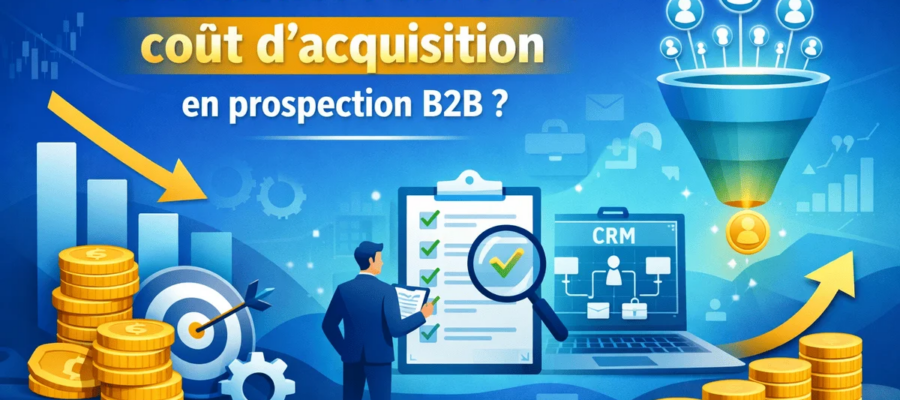
However, there is no shortage f prospecting levers: LinkedIn Ads, Google Ads, cold emailing, automated outbound, etc. Unfortunately, many companies invest without checking the quality of the data upstream.
👉 Result: a conversion tunnel saturated with poorly targeted leads, degraded marketing ROI and half-mast business transformation.
The reality is simple: you don’t reduce your acquisition costs by sending more messages. We reduce it by aiming better.
Here’s how to do it.
Understanding the cost of acquisition in commercial prospecting
Before we talk about optimization, we need to measure.
In B2B, every euro invested must produce a measurable return.
Definition of the acquisition cost in B2B
Customer acquisition cost (CAC) is the total amount invested to obtain a new customer.
The formula is simple:
Customer Acquisition Cost (CAC) = (Marketing Budget + Sales Budget) / Number of new customers acquired
In B2B prospecting, this includes:
- paid campaigns (LinkedIn Ads, Google Ads…)
- lead generation tools
- list of potential customers for purchase
- salaries of sales staff
- CRM software and automation tools
This figure determines the profitability of your B2B acquisition.
Marketing CAC vs. Commercial CAC: Don’t mix it up
We often distinguish two dimensions:
1) The marketing of the CAC
It brings together expenses related to lead acquisition: advertising, content, data, tools.
👉 Objective: feed the top of the conversion funnel.
2) The commercial CAC
It’s about turning leads into customers: sales times, reminders, meetings, closing.
👉 Objective: convert
In B2B, the true acquisition cost is the combination of the two.
Reducing your marketing budget alone isn’t enough if your business transformation is ineffective.
Why acquisition costs explode in B2B ?

If the acquisition cost increases, it is generally not a budget issue.
It’s a problem of method.
Here are the most common causes.
| Cause | What’s really happening | Impact on acquisition cost (CAC) |
| Bad segmentation | Too broad targeting (“French SMEs”), lack of precise criteria (sector, size, function, maturity) | Low response rate, irrelevant messages, poor conversion → CAC increasing |
| Outdated data | Invalid emails, contacts that have changed location, inactive companies | Investment in unusable leads → direct loss of marketing budget |
| Targeting too broad | Volume takes priority over quality | Artificially low CPL but very high cost per customer |
| Artisanal prospecting | Manual exports, enrichment on Excel, rough segmentation | Wasted sales time → reduced productivity → increased CAC |
| Poorly structured conversion funnel | No scoring, no prioritization, no automation, insufficient CRM monitoring | Unprocessed leads, poorly synced follow-ups, weak business transformation |
Buying a Lead List: Opportunity or Risk for Your B2B Acquisition?
Yes, it is an opportunity not to be missed but under certain conditions.
There is no value in purchasing a prospect list only if the data is structured, reliable and immediately actionable in your business prospecting strategy.
We must be uncompromising about the quality of information.
A good export shouldn’t be limited to a name and email address.
In particular, it must integrate:
- the precise function of the contact (and decision level)
- the sector of activity
- company size (staff, turnover)
- position
- clear identifying data (SIREN, website, domain)
- information that can be used for segmentation
Without these elements, it is impossible to optimize your conversion funnel or prioritize leads.
The second requirement concerns the updating and consistency of the data.
Out-of-date contacts worsen the deliverability and reputation of your domain and mechanically increase acquisition costs.
Finally, the structuring of the file is decisive.
Standardized columns, clean fields, and consistent formats allow for seamless integration into your CRM and automation tools.
It is precisely on these criteria that the purchase of a list of prospects is based. As Pharow explains, a solution that centralizes and keeps all data sources for your prospecting up to date, performance does not depend on volume, but on quality, segmentation and the ability to exploit data.
Method to immediately reduce acquisition costs
Reducing acquisition costs in B2B prospecting isn’t based on a “hack.”
It is a structured method, oriented towards data and commercial performance.
Here’s a workable approach.
1) Define your ICP precisely
Before any lead generation, clarify your ideal customer profile:
- target sector
- company size
- decision-making function
- business problem
- digital maturity
2) Segment before prospecting
Never launch a global campaign.
By segment:
- by business vertical
- by level of responsibility
- by geographical area
- by company size
Fine segmentation allows you to tailor your message and increase your response rate.
3) Structure your conversion funnel
Buying a prospect list shouldn’t be an isolated action.
Integrate your contacts into a clear funnel:
👉 Objective: transform data into measurable business opportunities.
4) Measure the acquisition cost by segment
Don’t think in terms of overall volume.
Analyze:
- CAC by sector
- CAC by function
- CAC per channel
- conversion rate per segment
You’ll quickly identify areas of performance… and sources of waste.
5) Optimize continuously
Effective B2B prospecting is an iterative process:
- Automate low-value tasks
- Adjust segmentation
- Refine your targeting
- Clean the data
- Test messages
Latest posts
Traditional vs digital advertising in 2026: which one to choose?

Duplicate Content: A Problem for Your Natural Referencing?

SEO Forums: The Complete List [2026]
How to build a successful linking strategy?

5 tips for successful marketing based on storytelling

Instagram profile photo: the practical guide [+Outils]

Twitter: 7 strategies to stand out

How to increase your awareness using digital?

Why premium domains improve your customer acquisition cost (CAC)