
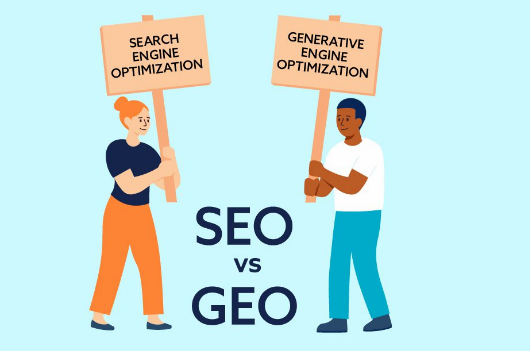
ChatGPT, Gemini, Perplexity, Mistral, etc. Searching for information using AI tools is becoming increasingly popular. Traditional search engine optimization (SEO) is evolving to accommodate the use of these platforms.
Surely you have come across the following terms:
Here in this article there is a clear explanation of these different concepts with their commonalities and differences.
The emergence of GEO
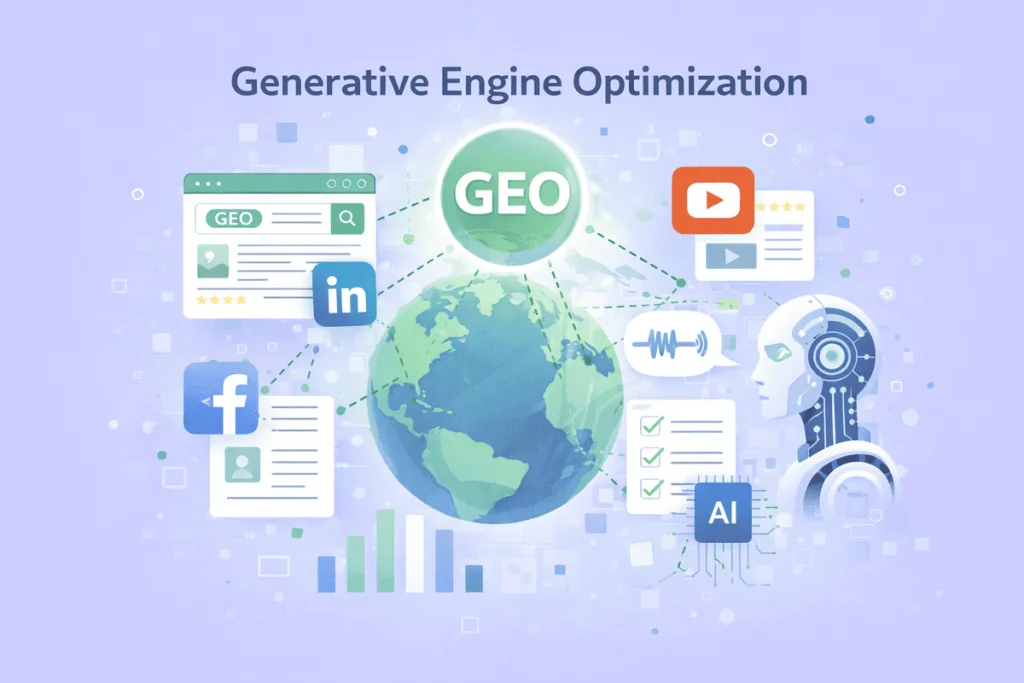
Artificial intelligence is being adopted at full speed. ChatGPT now has over 800 million active users.
For brands, the goal of the game is to appear on these new platforms by being mentioned and/or mentioned in responses.
For industry professionals: web agencies, SEO specialists, freelancers, AI engineers, etc. we had to find new words to designate this new discipline.
👉 The objective: to be able to offer clear and understandable offers to the general public.
The term “Generative Engine Optimization” or GEO is currently the most used:
Agencies today offer services dedicated to GEO:
Is this the end of SEO?
No, “SEO” search is still predominant with more than 30,000 searches per month in France:
We are gradually seeing an evolution towards “GEO SEO” or “SEO AI”.
SEO vs GEO: curriculum
| Criteria | SEO (Search Engine Optimization) | GEO (generative engine optimization) |
| Alternative terms | SEO, natural referencing | GEO, AIO, response engine optimization, SEO AI |
| Objectiv | Position yourself in the first SERP results and generate qualified traffic to your site | Be cited and/or mentioned in responses generated by LLMs |
| Platforms | Classic search engines: Google, Bing, etc. | AI and SGE response engines: ChatGPT, Claude, Gemini, Perplexity, Le Chat de Mistral, etc. |
| Results format | List of clickable links + rich snippet | Direct response with embedded quotes (even without clicking) |
| SEO logic | Optimize your pages to be indexed, crawled, classified, get links and strengthen your organic referencing | Optimize your content so that it is understandable, reliable, structured and reusable by artificial intelligence |
| Types of searches | Keywords and short sentences. Example: the best electric car | More complex long-tail questions and searches. Example: “What is the best electric car for a cold climate?“ |
| Importance of external signals | Backlinks are an important ranking criterion | Mentions and citations of your brand are essential |
| Key indicators | Organic traffic, click-through rate (CTR), positions, conversions | Citation rate and brand perception |
| Monitoring tools | Google AnalyticsGoogle Search Console | Manual test Brand monitoring tools AI Tools: Semrush, Peec AI, etc. |
What SEO and GEO have in common
1. Offer quality content
Reliable, unique and well-written content remains the basis for being visible on Google and artificial intelligence tools.
2. A clear and readable structure
Both SEO and GEO favor well-structured content with:
- clear titles and subtitles (H1, H2, H3).
- short paragraphs,
- bulleted lists and tables,
- precise targeting of subtopics.
This is especially important for LLM tools that need to generate concise responses.
3. Authority and credibility
Whether we’re talking about SEO or GEO, one principle remains unchanged: the more expert you are perceived to be, the more likely your content will be used as a reference.
In fact, this credibility is based on the following criteria:
Backlinks and external mentions
In SEO, quality inbound links strengthen organic rankings and signal to Google that your content deserves to be indexed and featured.
In GEO, these backlinks play an equally decisive role: Even without a clickable link, a textual mention in recognized content can strengthen your semantic weight and increase your chances of being mentioned in an AI response.
The EEAT signals (Experience, Competence, Authoritativeness, Reliability)
Google uses EEAT to evaluate the trustworthiness of a page.
Generative engines follow this logic: they favor content coming from expert sites, produced by identified authors and supported by evidence (studies, data, citations).
If your digital reputation aligns with your real-world experience, your content becomes easier to integrate into the responses you generate.
Proof of experience and legitimacy
Case studies, sector analyses, verified customer reviews, participation in conferences, specialized publications…
These elements play a key role in SERPs, but also in AI summaries, because they allow generative models to more clearly identify who is authoritative in a specific niche.
4. Alignment with user intent
In both approaches, the goal is not to multiply content, but to produce something that is actually in line with what the person wants to find, understand or solve.
To store: SEO and GEO have the same logic: to make content visible, reliable and useful to meet the needs of an Internet user.
5. The use of structured data
Both SEO and GEO rely on structured data to help engines (classical or generative) improve understand and extract your content.
In SEO, schema markup can improve visibility in SERPs via enriched extracts (rich snippet).
Here’s an example with embedded reviews:
In GEO, this same structuring facilitates the extraction and reuse of information by LLMs, who need clear benchmarks to generate a reliable response.
Example :
If you publish a comparative guide on the “best hotels in Lyon”, you can integrate the LocalBusiness, Hotel, AggregateRating and PostalAddress schemes.
The differences between SEO and GEO
SEO optimizes so that your site is consulted.
GEO optimizes so that your brand is used as a reference in an AI response.
Examples of differences
| Situation | SEO result | GEO result |
| One agency offers an “SEO audit” guide. | The guide appears on page 1 of Google on “SEO audit”. | In ChatGPT, the brand is cited as an example of a GEO audit in a response, even if the link is not clicked. |
| A restaurateur from Toulouse gets a link in a local newspaper. | The site is advancing in Google’s local results | The restaurant is mentioned in an AI recommendation along with other popular spots in the city. |
| A brand publishes an expert article with numerical data. | The article generates impressions and clicks. | Statistics are included in Gemini, which generates visibility + trust. |
Different KPIs
The traffic generated to your site is no longer the only indicator of success.
With the arrival of AI, other parameters must be taken into account:
To measure these KPIs, you can run manual tests or use tools like the Semrush AI Kit:
GEO: what changes for your brand?
GEO does not replace SEO, but several adjustments are needed.
Create content designed to be cited
AIs better understand contents that follow an informative logic: definitions, data, concrete examples, methodologies, FAQs.
Do :
✅ Bring original ideas, real-world experience and clear skills.
✅ Write content that exactly satisfies the intent of your users.
✅ Multiply formats, frameworks, checklists, “how-to” definitions.
✅ Think “one idea = one paragraph”.
✅Write practical cases.
Diversify your presence beyond Google
Generative engines are not only based on websites indexed by Google: they also analyze videos, social networks, studies, media, etc.
To be mentioned in AI responses, you must therefore diversify your presence.
Do :
✅ Be active on Reddit, YouTube, LinkedIn
✅ Distribute your content across multiple platforms
✅ Vary formats: long posts, scripts, transcriptions, expert comments.
Measure your AI visibility, not just your organic traffic
With generative research the user gets an answer without necessarily clicking.
You then need to monitor new indicators to understand where your AI visibility stands
Do :
✅ Track your AI traffic
✅ Track your AI citation rate
✅ Analyze your textual mentions (even without links)
To conclude: the next step
With the adoption of artificial intelligence, should you change everything in your SEO strategy?
The answer is no.
The basics remain the same: offer quality content that truly satisfies search intent, continue to obtain backlinks and take care of the technical aspects of your website.
To be visible in ChatGPT, Gemini, Claude, etc., however, you need to have a real brand strategy and increase your presence.
Frequently asked questions
Latest posts
Traditional vs digital advertising in 2026: which one to choose?

Duplicate Content: A Problem for Your Natural Referencing?
SEO Forums: The Complete List [2026]
How to build a successful linking strategy?

5 tips for successful marketing based on storytelling

Instagram profile photo: the practical guide [+Outils]

Twitter: 7 strategies to stand out

How to increase your awareness using digital?

Why premium domains improve your customer acquisition cost (CAC)